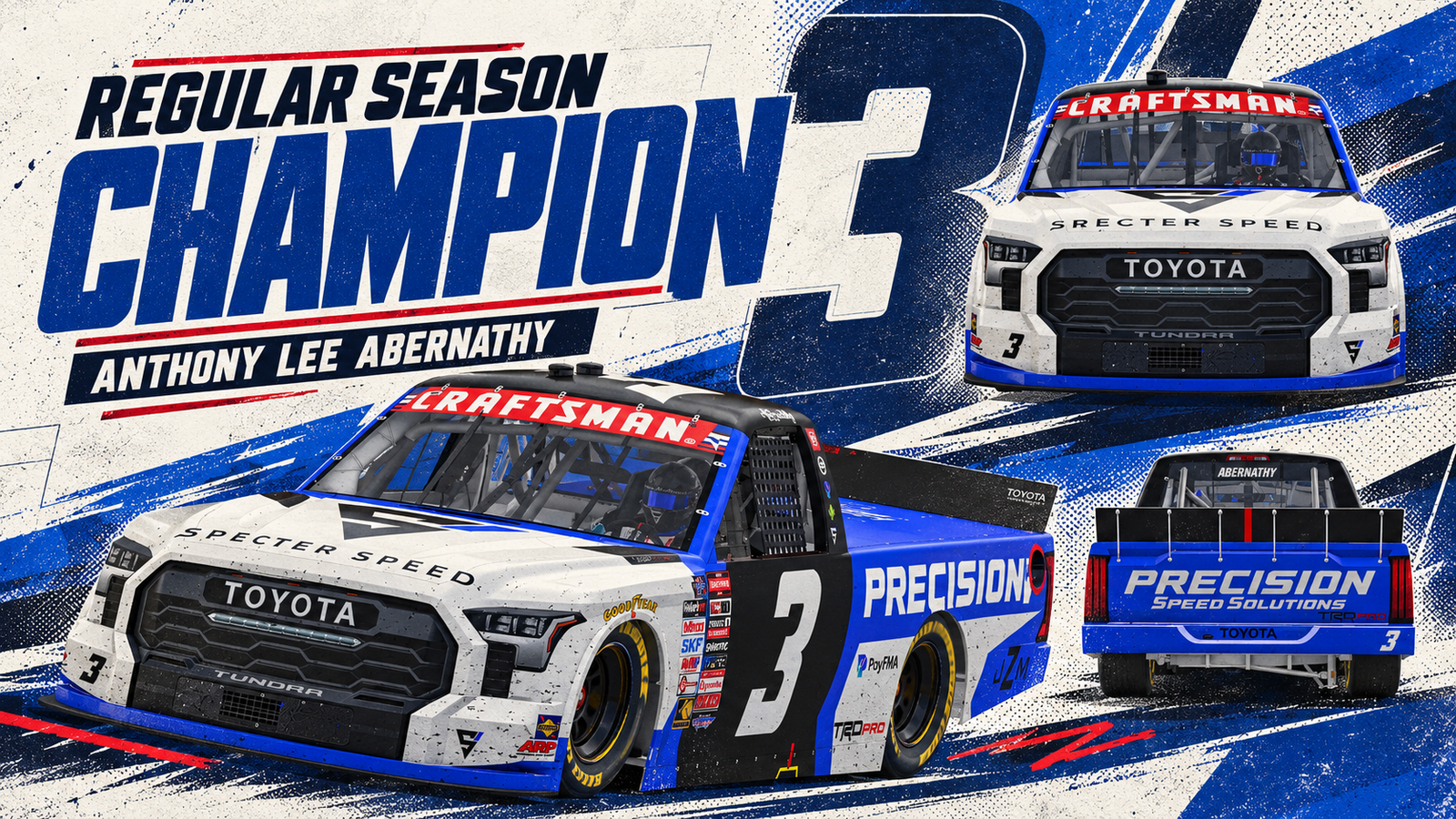
While victories were spread among some of the series’ most formidable competitors, Anthony Lee Abernathy delivered the sustained performance needed to emerge as Major League Sim Racing’s inaugural C-Open Regular-Season Champion.
The Championship Story
Twelve races. Twelve different opportunities for a championship campaign to unravel.
For Anthony Lee Abernathy, the inaugural Major League Sim Racing C-Open regular season wasn’t defined by a single dramatic victory or one extraordinary night. It was defined by something far more difficult to sustain: the ability to remain a championship contender across an unforgiving collection of racetracks.
From the high banks of Daytona to the demanding corners of Bristol, the intermediate speedways and the technical challenges of Gateway, Abernathy assembled the body of work necessary to claim the C-Open Regular-Season Championship.
It was a championship earned across the schedule, not in a single moment.
And in a series featuring Christian Barnes, Connor Cunningham, Max Ford, Ethan Thompson and a deep field of capable contenders, that distinction mattered.
“You have to be consistent if you want to contend for the championship.”
— Precision Entertainment broadcast commentary, Gateway
A Different Kind of Championship Fight
The opening portion of the season quickly established that the C-Open championship would not belong to anyone without a fight.
Christian Barnes became the early benchmark for outright winning performance, putting together three consecutive victories and establishing himself as one of the most dangerous drivers in the field.
Yet by the time the series reached Texas Motor Speedway for Round 5, it was Abernathy sitting atop the championship standings.
That contrast became one of the defining stories of the regular season.
Barnes was collecting victories. Abernathy was collecting the points necessary to lead the championship.
The distinction was significant. A 12-race regular season offers little room for repeated setbacks, particularly against a field where multiple drivers have the speed to win on any given night.
Abernathy’s approach was not immune to difficult results. At Texas, he finished 12th while Cunningham captured his first victory of the season. It was a reminder that even the points leader could find himself outside the top 10.
But a championship campaign is measured by more than what happens when everything goes right.
It is also measured by what happens afterward.
Surviving a Changing Landscape
As the schedule progressed, the variety of racetracks placed increasingly different demands on the championship contenders.
Darlington rewarded precision and patience. Echo Park Speedway introduced its own strategic challenges. Chicagoland tested long-run execution, while Bristol placed an enormous premium on survival and track position.
At the same time, the list of race-winning threats continued to grow.
Max Ford emerged as a winner at Darlington and Bristol. Cunningham continued establishing himself as a force capable of winning repeatedly. Ethan Thompson added a victory at Kansas, and Chris Cornett delivered a breakthrough performance at Gateway.
There was no shortage of drivers capable of taking the checkered flag.
Yet through those changing conditions, Abernathy remained at the center of the championship conversation.
By the time the series reached Gateway for the penultimate round of the regular season, the Precision Entertainment broadcast was still identifying Abernathy as the points leader and highlighting his performance across a variety of tracks.
It was perhaps the clearest indication of what had separated his season from the rest.
The championship wasn’t being decided by who could dominate one type of racetrack.
It was being decided by who could produce the strongest overall season.
The Final Stretch
Gateway provided another example of the competition Abernathy had faced throughout the year.
Chris Cornett emerged victorious after a tense late-race battle with Shawn Hook, while Abernathy finished eighth.
For a driver protecting a championship lead, it was another points-paying finish at a moment when the regular season was running out of opportunities.
The following week, the series traveled to Charlotte Motor Speedway for its regular-season finale.
The stakes extended well beyond the championship leader.
Drivers throughout the field were fighting to secure positions in the 10-driver Chase, and every finishing position had the potential to reshape the postseason lineup.
Abernathy entered Charlotte as one of the season’s leading points performers, but the final race still demanded execution.
Starting 13th, he had to work forward through traffic while the battle at the front developed around some of the series’ fastest competitors.
Cunningham ultimately took the victory at Charlotte, completing the regular season with four wins and strengthening his credentials as a postseason championship threat.
But the larger 12-race picture belonged to Abernathy.
When the regular season was complete, the distinction was clear.
Cunningham had amassed an impressive victory total. Barnes had demonstrated exceptional winning speed. Ford, Thompson and others had produced their own standout performances.
Abernathy had secured the regular-season championship.
A Title That Means Something
In a championship format where the final four races will ultimately decide the overall season champion, the regular-season title deserves recognition of its own.
It represents the strongest points campaign across 12 races and a schedule designed to test different strengths.
For Abernathy, that means recognition for more than an individual result.
It means being the driver who successfully navigated the opening chapter of MLSR’s inaugural C-Open season.
The accomplishment also establishes an important benchmark for the organization. As Major League Sim Racing continues developing its competitive structure, the regular-season championship recognizes a different form of excellence from the eventual Chase title.
One rewards performance across the long campaign.
The other will be decided under the concentrated pressure of the final four races.
Both matter.
The Chase Awaits
The celebration of the regular-season championship does not mean the season is over.
If anything, it marks the beginning of a different challenge.
The same competitors who spent 12 weeks chasing Abernathy in the standings now have another opportunity to compete for the ultimate championship.
Cunningham enters with the momentum of four regular-season victories. Barnes has already demonstrated the ability to win repeatedly. Other contenders have shown that strategy, execution and a well-timed performance can change the outcome of a race.
For Abernathy, the task is straightforward, even if accomplishing it will be anything but easy.
The consistency that earned him the regular-season title must now translate into performance when the championship pressure is at its highest.
But whatever happens over the final four races, one achievement is already his.
Anthony Lee Abernathy is the inaugural Major League Sim Racing C-Open Regular-Season Champion.
Twelve races established the standard.
Now comes the Chase.